10 Garage Door Mistakes Homeowners Make — And How to Avoid Every One of Them

A garage door is a long-term investment. Choose and install the right one, maintain it correctly, and it will serve your home reliably for 20–30 years. Make a few preventable mistakes along the way — in the buying decision, the installation, the maintenance routine, or the repair choices — and that same system becomes a recurring source of problems, expense, and frustration.
The ten mistakes covered in this guide are among the most common that homeowners make with their garage door systems. Some happen at the point of purchase, some during ownership, and some at the point of repair. All of them are avoidable with the right information—which is exactly what this guide provides. If you have questions about selecting, maintaining, or repairing your garage door, Contact Us at State Line Garage Doors for expert guidance and professional assistance tailored to your needs.
Mistake 1: Choosing the Door Based on Price Alone
The least expensive garage door at the point of purchase is rarely the least expensive door over ten years. Budget doors use thinner steel that dents and rusts more easily, lower-quality insulation that performs poorly, and hardware that wears faster and requires earlier replacement. The premium between a builder-grade door and a mid-range quality door is often $300–$500 — a fraction of the cost difference in maintenance, repairs, and early replacement that the cheaper door will generate.
What to do instead:
Evaluate total cost of ownership, not sticker price. Factor in the door’s rated lifespan, insulation value and its impact on energy bills, the quality of included hardware, and the manufacturer’s warranty. A door that costs $400 more upfront but lasts 8 years longer and requires half the maintenance is the better investment by a significant margin.
Mistake 2: Ignoring Insulation
Skipping insulation to save money on a garage door is one of the most common and most regretted decisions homeowners make. An uninsulated door has an R-value of roughly R-2. For an attached garage — which shares walls directly with the living space — that’s a significant thermal weak point that drives up energy costs year-round and makes the garage unusable as a workspace in temperature extremes.
The full cost of skipping insulation:
• Higher heating and cooling costs through a thermally weak wall
• Damage to stored items — paint, electronics, vehicles — from temperature extremes
• A garage that’s unusable as a workspace for much of the year
• A structurally weaker door that dents more easily and resonates more noise
What to do instead:
Specify R-12 or higher for any attached garage. R-16 or above if there is living space above the garage. The upgrade cost from an uninsulated to an insulated door is typically $150–$300 and pays back in energy savings within a few years.
Mistake 3: Choosing a Style That Clashes With the Home
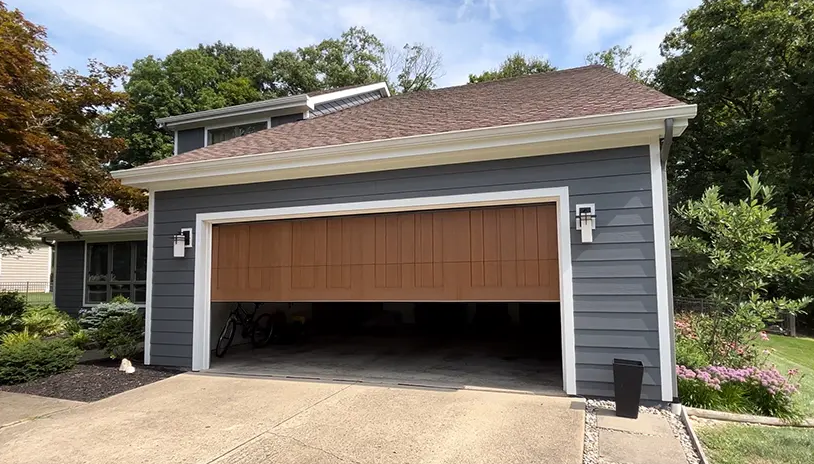
A garage door that doesn’t fit the home’s architectural style is immediately noticeable — even to buyers and visitors who can’t articulate exactly why it looks wrong. A contemporary full-view glass door on a traditional Colonial home, a raised-panel steel door on a modern farmhouse, or a wood door with the wrong tone on a brick exterior all create visual friction that undermines curb appeal and, by extension, home value.
What to do instead:
Start with the home’s architectural style and let that guide the door selection. Traditional homes suit raised-panel or carriage-house designs. Craftsman homes pair well with horizontal plank detailing and warm tones. Contemporary builds call for clean-lined aluminum or flush steel. Use a door design visualization tool — most major manufacturers offer them — to see exactly how different doors look on your specific home before committing.
Mistake 4: Sizing the Door for Today’s Vehicles Instead of Tomorrow’s
One of the most consistently regretted garage door decisions is sizing the opening too small. A standard 8-foot single door feels adequate until you buy a full-size truck, add a roof rack, or bring home an SUV with wide mirrors. A standard 7-foot height becomes a problem the day you lift the vehicle, install a rooftop cargo box, or purchase a cargo van.
The numbers that matter:
• Width: A 9-foot single door is the comfortable minimum for modern trucks and SUVs. A 10-foot door is the enthusiast’s choice — plenty of clearance for wide vehicles and working alongside them.
• Height: If a car lift is even a remote possibility, plan for 10-foot doors minimum. 12-foot is ideal for two-post lifts. Standard 7-foot doors lock out most lift configurations entirely.
• Two doors vs. one: Two 9-foot doors side by side is almost always preferable to a single 16-foot double door — independent operation, better insulation, and easier replacement if one panel is damaged.
What to do instead:
Size for the vehicles and uses you might have in five to ten years, not just what’s in the driveway today. Widening or raising a garage opening after the fact is a major structural project. Getting it right at installation is dramatically less expensive.
Mistake 5: Attempting DIY Installation
Garage door installation looks achievable on YouTube. It isn’t. The most dangerous step — torsion spring tensioning — requires specialized winding bars and precise knowledge of the correct number of turns for the specific door weight. A miscalculation or equipment slip during this step can release spring tension catastrophically, causing severe injury or death. This risk is present every time a spring is wound, adjusted, or replaced.
Beyond the safety issue, DIY installations frequently produce misaligned tracks, incorrect spring tension that shortens component lifespans, improper opener programming that creates safety hazards, and installation errors that void manufacturer warranties. The cost of professional installation is typically 15–25% of the total project cost — a modest premium for safety, quality, and warranty protection.
What to do instead:
Hire a licensed, insured garage door professional for installation. Ask about the warranty on parts and labor, and confirm the installation will include a full safety inspection — balance test, auto-reverse test, and sensor alignment — before handover.
Mistake 6: Skipping Lubrication
Lubrication is the single highest-impact, lowest-cost maintenance task for a garage door system — and the one most consistently skipped. Without regular lubrication, rollers grind against dry tracks, hinge pins squeak in dry brackets, and spring coils stress against each other without the protection of a thin grease layer. The accumulated wear from operating dry costs years of component lifespan.
The lubrication mistakes within the mistake:
• Using WD-40: WD-40 is a water displacer, not a lubricant. It evaporates quickly and attracts dirt, leaving components worse off than before.
• Lubricating the tracks: Tracks should be clean but not lubricated — a greasy track causes rollers to slip rather than roll, creating binding and uneven movement.
• Skipping the springs: Springs benefit most from lubrication — white lithium grease applied to the coils reduces friction between coil contact points and slows surface corrosion significantly.
What to do instead:
Lubricate every six months: silicone spray on rollers, hinges, and the inside of the track channel (not the rolling surface); white lithium grease on torsion springs and the opener’s drive chain or screw. The process takes 10–15 minutes and extends the lifespan of every moving component significantly.
Mistake 7: Ignoring Warning Sounds
A garage door communicates its condition through sound. Grinding, squeaking, rattling, straining, popping, and scraping are all diagnostic signals — each pointing to a specific component or problem. Homeowners who tune out these sounds and wait until the door stops working are consistently paying more for their repairs than those who call when they first notice something has changed.
Sound-to-problem quick reference:
• Grinding: Worn rollers, stripped opener gears, or misaligned track
• Squeaking: Dry hinges or springs — lubricate first, replace if squeaking continues
• Loud bang: Broken torsion spring — stop operating the door immediately
• Rattling: Loose hardware — tighten before it worsens
• Straining motor: Spring imbalance or binding — perform the balance test
• Scraping: Door contacting frame or floor — stop using and call for service
What to do instead:
Listen actively to your garage door as part of your daily routine. When something sounds different from last week, investigate. A new noise is almost always cheaper to address today than next month.
Mistake 8: Replacing Only One Spring When One Breaks
When a torsion spring breaks, most homeowners ask to have just the broken spring replaced. This feels like the obvious and economical choice. It isn’t. Springs are installed as a matched pair and wear together through the same number of cycles. If one has reached the end of its service life, the other is at exactly the same point. Replacing only the broken spring means the second will fail — typically within weeks or months — triggering another service call and another round of labor costs.
The math:
Two springs replaced at the same time: one labor charge, two springs. Two springs replaced six weeks apart: two labor charges, two springs. The total cost of replacing them separately is consistently higher than replacing both at once — and the second failure almost always happens at an inconvenient time.
What to do instead:
Always replace both springs simultaneously. A quality technician will recommend this automatically — if they don’t, ask why. Consider upgrading to high-cycle springs (25,000–50,000 cycles) at replacement time, which extend the replacement interval significantly for a modest premium.
Mistake 9: Keeping an Outdated Opener Too Long
A garage door opener that’s still technically working is easy to keep indefinitely. But openers more than 10–15 years old are missing features that have become standard — and in some cases, carrying security vulnerabilities that are actively exploited by thieves.
What older openers are missing:
• Rolling code security: Fixed-code openers manufactured before the mid-1990s transmit the same signal every time the remote is pressed. These signals can be captured and replayed by anyone with a code grabber device.
• Battery backup: An opener without battery backup is completely inoperable during a power outage — a significant problem when the garage is the primary entry point.
• Smart connectivity: Remote monitoring, real-time alerts, auto-close scheduling, and app control are standard on modern units and meaningfully improve daily convenience and security.
• Quiet operation: Modern belt drive and direct drive openers are dramatically quieter than older chain drives, a significant quality-of-life improvement for garages adjacent to living spaces.
What to do instead:
If your opener is more than 10 years old, evaluate it honestly against current options. If it’s more than 15 years old and still using fixed-code technology, replacement is a security and convenience upgrade that pays for itself quickly in both peace of mind and the features you gain.
Mistake 10: Skipping the Annual Professional Inspection
Most homeowners call a garage door professional only when something breaks. This reactive approach consistently costs more than a proactive one. Springs warn before they fail — a technician measuring tension loss can replace them on your schedule rather than after the loud bang at 7 AM. Cables fray progressively before they snap — visible early if someone is looking. Tracks drift gradually before they cause a rail failure. None of these failures are truly sudden to someone who’s been watching.
What a professional annual inspection covers:
• Full visual inspection of panels, tracks, rollers, hinges, springs, cables, and hardware
• Spring tension measurement and adjustment
• Cable condition assessment for fraying or corrosion
• Balance test and opener force calibration
• Safety sensor alignment and auto-reverse function test
• Written condition report identifying components approaching end of life
What to do instead:
Schedule an annual professional inspection every fall — before the colder months that stress components more. The cost is a fraction of any single emergency repair and consistently prevents the more expensive failures from happening at the worst possible times.
See also: A Complete Guide to Performance Wear for Modern Businesses
The Ten Mistakes at a Glance
1. Choosing on price alone — evaluate total cost of ownership
2. Skipping insulation — R-12 minimum for attached garages
3. Style mismatch — match the door to the home’s architecture
4. Sizing too small — plan for future vehicles and uses
5. DIY installation — springs make this genuinely dangerous
6. Skipping lubrication — twice a year, right products, right components
7. Ignoring warning sounds — every new noise is diagnostic information
8. Replacing only one spring — always replace both simultaneously
9. Keeping an outdated opener — fixed-code security is a real vulnerability
10. Skipping annual inspections — proactive care is always cheaper than reactive repair
Final Thoughts
Every one of these mistakes is avoidable — and every one of them is more expensive to correct after the fact than to prevent in the first place. The homeowners who get the most out of their garage door systems are not those who spend the most money. They’re the ones who make informed decisions at the point of purchase, maintain their systems consistently, pay attention to how the door sounds and behaves, and call a professional at the first sign of a problem rather than the last.
A garage door is a 20–30 year investment. Treat it like one.
Have questions about your current garage door system, or ready to make a smart upgrade? State Line Garage Doors helps homeowners avoid costly mistakes with expert advice, professional installation, and comprehensive service. Contact us today for a free estimate.
About the Author:
This post was developed with garage door industry professionals to help homeowners make smarter decisions at every stage of garage door ownership — from the initial purchase through decades of maintenance and repair.