How to Build the Ultimate Car Enthusiast Garage: Doors, Layout, and Everything in Between

For car enthusiasts, the garage isn’t just a place to park — it’s a sanctuary. It’s where weekends disappear into engine bays, where tools have names and stories, and where the smell of oil and rubber feels like home. But too many enthusiast garages are let down by the one thing people think about last: the garage door.
The right garage door setup does more than open and close. It determines how much light floods your workspace, how well your tools and vehicles are protected, how easy it is to move cars in and out, and whether your garage looks like a professional setup or an afterthought. This guide covers everything a car enthusiast needs to know to build a garage that’s as serious as their hobby.
1. Size Matters More Than You Think — Plan for the Cars You Want, Not Just the Cars You Have
The single biggest regret among car enthusiasts who build or renovate a garage is not going big enough. It’s tempting to size your door opening for your current vehicles, but your collection has a way of growing.
Standard garage door widths and what they actually accommodate:
• 8 ft single door: Fits one standard car with little room to spare. Too tight for trucks, SUVs, or working alongside the vehicle.
• 9 ft single door: The comfortable minimum for a single-car bay. Fits trucks and SUVs and gives you room to open doors fully.
• 10 ft single door: The enthusiast’s choice for a single bay. Plenty of clearance for wide vehicles, trailers, and moving around the car comfortably.
• 16 ft double door: Standard two-car width. Works, but a single large panel can be harder to seal and insulate than two separate doors.
• Two 9–10 ft doors side by side: The preferred configuration for a two-car enthusiast garage. Each door can be operated independently, giving you flexibility and better sealing.
Height is just as important. Standard 7 ft doors are tight for lifted trucks, vans, or vehicles on a lift. If there’s any chance you’ll install a car lift in the future — and there should be — plan for 10 ft doors minimum, with 12 ft being ideal for two-post lifts.
2. The Case for Full-View Glass Garage Doors in an Enthusiast Build
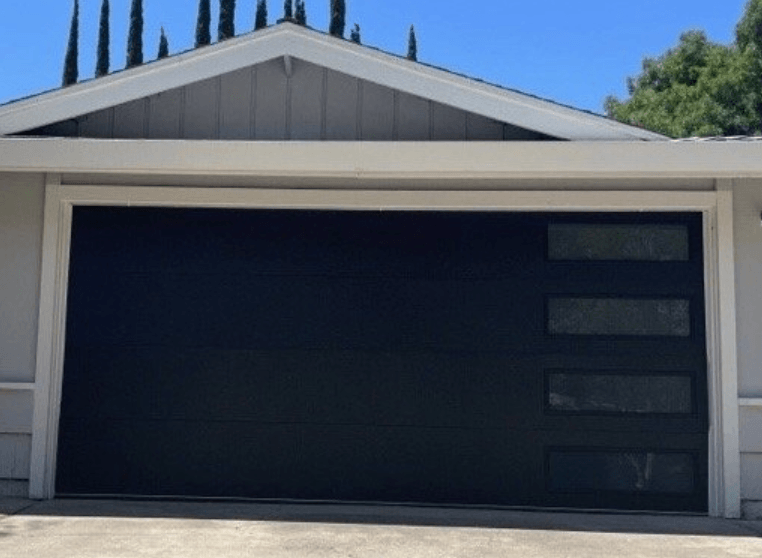
Full-view aluminum garage doors with glass panels have exploded in popularity among car enthusiasts and for good reason. If you’ve invested serious money and time into your garage setup — epoxy floors, tool chests, a lift, a collection worth showing off — a full-view door lets you display it like the showroom it deserves to be.
The practical benefits go beyond aesthetics:
• Natural light: Glass panels flood the workspace with daylight, reducing eyestrain during detailed work and making paint defects and body lines easier to see clearly.
• Curb appeal: A full-view door with a clean, well-lit garage behind it is a genuine showstopper. It elevates the entire property.
• Modern aesthetic: Clean aluminum frames and glass panels complement contemporary and industrial design styles that are popular in enthusiast builds.
• Glass options: Choose from clear (maximum light, full visibility), frosted (diffused light, privacy), tinted (reduces glare and UV), or insulated double-pane glass for better thermal performance.
The main tradeoff is insulation — glass panels inherently perform worse thermally than solid insulated panels. If you’re in a climate with extreme heat or cold, factor in supplemental heating or cooling for the workspace, or opt for insulated glass units.
3. Insulation: Protecting Your Investment and Your Comfort
A car enthusiast’s garage is often home to tens of thousands of dollars worth of vehicles, tools, and equipment. An uninsulated garage door is the weak link in protecting all of it.
Here’s what poor insulation actually costs you:
• Paint and finish damage: Extreme temperature swings cause vehicle paint and clearcoat to expand and contract repeatedly, accelerating micro-cracking and oxidation over time.
• Battery drain: Cold temperatures kill batteries faster. Classic cars and project vehicles sitting in an unheated garage will need frequent jump-starts or trickle chargers.
• Fluid viscosity: Oil, brake fluid, and coolant behave differently at temperature extremes. A garage that stays closer to a stable temperature is better for stored vehicles.
• Tool and equipment lifespan: Electronics, compressors, and precision tools all last longer in a temperature-stable environment.
• Your own comfort: You can’t do good work when you’re freezing or sweating through your shirt. An insulated garage is a usable garage year-round.
For a working enthusiast garage, target R-16 or higher on the garage door. Pair it with insulated walls and a well-sealed ceiling for maximum thermal performance.
4. Opener Specs for Enthusiast Use: Power, Speed, and Reliability
A standard residential garage door opener is designed for a door that opens once or twice a day. In an active enthusiast garage, you might be cycling the door a dozen times on a project weekend. That means you need an opener built for more demanding use.
Horsepower
Bigger, heavier doors need more power. A standard ½hp opener is fine for a lightweight uninsulated door, but a heavy insulated door or an oversized door (10 ft+) needs at least 1.25 hp, with 1.5 hp being the choice for demanding applications. Undersizing the motor leads to premature wear and unreliable operation.
Drive Type
For an enthusiast garage, a belt drive or direct drive opener is the right call. Both are significantly quieter than chain drives — important when you’re doing precision work and don’t want vibration rattling through the structure every time the door cycles. A jackshaft (wall-mount) opener is also worth considering if you want to maximize ceiling space for a lift or overhead storage.
Speed
Commercial-grade openers operate at higher speeds than standard residential units — some opening a full door in under 10 seconds vs. the standard 12–15. In a busy garage, faster cycling is a genuine quality-of-life improvement.
Smart Features
Look for: battery backup (so a power outage doesn’t trap a car inside), Wi-Fi connectivity for remote monitoring, and myQ or equivalent app integration so you can confirm the door is closed from your phone after leaving.
5. Garage Door Layout for Car Lifts
If a car lift is in your plans — now or ever — your garage door decision needs to account for it from the start. Retrofitting a lift into a garage with the wrong door configuration is an expensive headache.
Key planning considerations:
• Two-post lifts: Require significant ceiling clearance above the vehicle — typically 11–12 ft of ceiling height minimum, which means a 10 ft door opening at minimum. The lift posts need to be positioned so vehicles can enter and exit without obstruction.
• Four-post lifts: Have a larger footprint but are more forgiving of ceiling height. However, they need wide door openings to accommodate the ramps and the vehicles driving onto them.
• Scissor lifts and low-rise lifts: More flexible in terms of ceiling clearance but still need adequate door height for comfortable vehicle entry.
• Headroom for the door itself: The door tracks and opener take up ceiling space. A high-lift or vertical-lift track conversion can maximize usable ceiling height by routing the door panels straight up rather than curving them into horizontal ceiling space — ideal for lift installations.
See also: Home Communion Set Explained – Purpose, Components, and Benefits
6. Lighting, Ventilation, and the Details That Make a Great Workspace
The garage door choice ripples into every other aspect of the workspace. Here’s how to think holistically about the build:
Lighting
Glass panel doors provide natural light during the day but do nothing at night. Plan for high-output LED shop lights — at least 5,000 lumens per bay — positioned to eliminate shadows under the vehicle and across the work surface. Color temperature matters: 5000–6500K (daylight range) is ideal for seeing paint colors and body lines accurately.
Ventilation
Running engines indoors without proper ventilation is dangerous. Even well-sealed garages with insulated doors need an exhaust system if you plan to run vehicles inside. Options include: through-wall exhaust fans, ceiling-mounted ventilation fans, or a dedicated vehicle exhaust extraction system that connects directly to the tailpipe.
Floor
Epoxy or polyurea floor coatings are the standard for serious enthusiast garages. They’re easy to clean, resistant to oil and chemical spills, and make the space look professional. Make sure the floor coating is applied before finalizing the garage door installation so the threshold seal sits correctly on the finished surface. If you’re unsure about selecting the right door system or need expert installation advice, Reach out to Reveille Garage Door Service for professional guidance tailored to your garage setup.
7. Security for High-Value Vehicles
A garage full of collector cars, performance vehicles, or high-end tools is a target. Standard residential garage door security isn’t designed with this in mind. Enthusiasts with valuable collections should layer their security:
• Upgrade to a rolling-code opener: If your opener is more than 10–15 years old and uses fixed codes, it can be cloned. Modern rolling-code systems generate a new code with every use.
• Secure the emergency release: The red emergency cord can be exploited via the top gap of the door. A zip tie through the release lever or a defender shield blocks this attack vector.
• Add a secondary lock: A slide bolt or cane bolt on the inside of the door adds a physical barrier beyond the opener lock — useful when you’re away for extended periods.
• Install a security camera: Position a camera to cover the garage door and driveway. Modern cameras with motion detection and app alerts give you real-time awareness of any activity.
• GPS trackers on vehicles: For collector or high-value vehicles, a hidden GPS tracker is an inexpensive insurance policy that dramatically improves recovery odds if a vehicle is stolen.
8. Maintenance Schedule for a Hard-Working Enthusiast Garage Door
A door that cycles frequently in an active garage needs more attention than a standard residential door. Follow this schedule to keep it operating reliably:
• Monthly: Visual inspection of springs, cables, and rollers; test auto-reverse safety function by placing a 2×4 under the door
• Every 3 months: Lubricate rollers, hinges, springs, and tracks with a silicone or lithium-based lubricant; check all hardware for tightness
• Every 6 months: Balance test — disconnect the opener and manually lift the door halfway; it should stay in place without drifting up or down
• Annually: Professional inspection and tune-up, including spring tension check, cable condition assessment, and opener force adjustment
Final Thoughts
The best enthusiast garage builds are the ones where every decision was intentional — including the doors. The right door size, material, glazing, insulation, and opener transforms a standard garage into a proper workshop that protects your vehicles, supports your work, and looks the part.
Don’t leave the door selection as an afterthought. It’s the first thing you see, the last line of defense, and the gateway to everything you love about the hobby. Get it right from the start.
Ready to upgrade your garage door to match the rest of your build? Rev Up Doors specializes in garage door solutions for homeowners who take their garage seriously. Contact us today for a free consultation and let’s build something worth showing off.
About the Author: This post was developed with garage build specialists and car enthusiasts to help hobbyists make smarter decisions about the most important feature of their workspace.