How to Photograph a Hillside Home Without Losing Its Architecture

Why elevation, camera position, and site context matter more than a dramatic view
A hillside home can be one of the most challenging properties to photograph. The view might be spectacular, the architecture might be exceptional, and the outdoor spaces might be beautifully designed. Yet the photographs can still fail to explain the house.
The problem often begins with the photographer’s position.
From the street, a hillside residence might appear to be a modest single-story building. From the opposite side, it could reveal three levels of living space, suspended terraces, and an entirely different architectural character.
Neither view is necessarily wrong. But neither tells the complete story on its own.
Understanding how the building responds to the slope is the starting point for photographing it properly.
The Ground Is Part of the Architecture
On a flat lot, the relationship between the house and its surroundings is often relatively straightforward. The front elevation, rear garden, and interior spaces can generally be understood from a few conventional viewpoints.
A steep lot changes that relationship.
The driveway might enter at the uppermost floor. A staircase may connect several outdoor terraces. The living room might extend toward the view while the bedrooms occupy a quieter level beneath it.
These decisions are often fundamental to the design.
A photograph that removes the surrounding land from the composition can make the building appear disconnected from the conditions that shaped it.
Even a small amount of context can make a difference. A retaining wall, a descending walkway, or the natural hillside beneath a terrace helps explain how the structure occupies the site.
Los Angeles City Planning’s Citywide Design Guidelines address the relationship between buildings, their surroundings, and natural topography. The same relationship deserves attention when the completed architecture is photographed.
Start With the Approach, Not the View
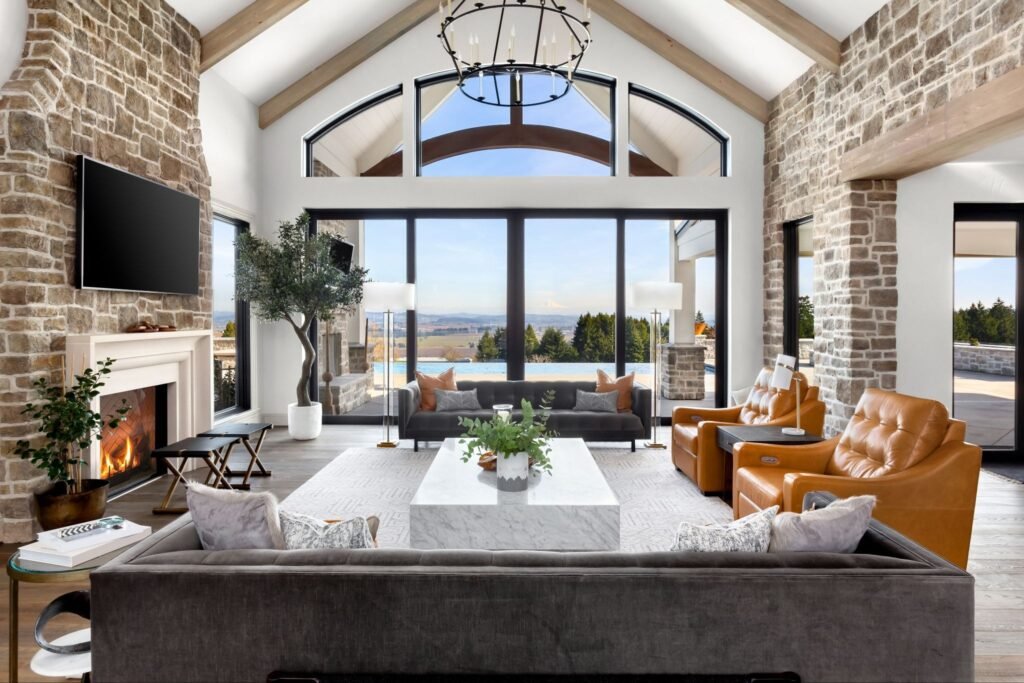
When a property overlooks Los Angeles, it is tempting to begin with the skyline.
But the skyline is only part of the experience.
Consider a house where visitors enter from an elevated driveway, move through a relatively enclosed entrance, and arrive at a living room overlooking the city.
That change from enclosure to openness may be one of the building’s defining features.
A useful photographic sequence begins before the view is revealed. It establishes the approach, shows the entrance, and then introduces the room where the landscape becomes visible.
The viewer can understand not only what the view looks like, but how the house reveals it.
This distinction is explored in ArchEyes’ feature on photographing Los Angeles architecture, which examines how light, topography, and movement through a building shape its photographic interpretation.
For a hillside residence, that approach helps distinguish architectural photography from a collection of attractive property images.
Choose Camera Height With the Slope in Mind
Camera height influences how a building’s proportions are perceived.
A low position can exaggerate an elevated deck or make a retaining wall dominate the composition. A high position can flatten the apparent change in elevation, making separate floors look more closely connected than they are.
Before setting up the tripod, walk around the property and compare several positions.
Look for a viewpoint that shows the relationship between the main structure, the supporting ground, and any significant outdoor spaces.
Sometimes the most informative photograph comes from halfway down a staircase rather than the driveway or the bottom of the lot.
This also applies indoors.
In a living room overlooking a valley, placing the camera too close to the window can make the view dominate the photograph while concealing the room itself.
Moving farther back can introduce the ceiling, floor, and surrounding walls, giving the window a meaningful position within the architecture.
The objective is not simply to include more scenery. It is to establish why the scenery matters to that particular room.
See also: What to Check Before Adding an Extension to Your Home
An Aerial Photograph Should Answer a Question
Drone photography can be valuable on a steep property, especially when the site’s organization is difficult to understand from ground level.
An elevated view might reveal how terraces connect, where the entrance sits relative to the living spaces, or how two separate structures share the same lot.
However, an aerial photograph taken too high can reduce the house to a roof surrounded by landscaping.
An oblique viewpoint may provide more architectural information by retaining the façades while revealing changes in elevation.
Before taking off, consider what the image needs to explain.
If the objective is to show the connection between three levels of outdoor space, position the camera accordingly. If the objective is to establish the property’s relationship with the surrounding neighborhood, a wider contextual view may be appropriate.
Height alone does not make an aerial photograph useful.
Photograph the Building at the Right Time
Hillside properties create complicated lighting conditions.
A residence might receive direct sunlight on one elevation while the opposite side remains shaded by the slope. Overhangs, mature trees, and neighboring buildings can further complicate the situation.
The most flattering time for the skyline may not be the most useful time for photographing the architecture.
A west-facing living room, for example, can experience strong afternoon light that makes interior exposure difficult. Returning when the light is softer may reveal more of the room’s materials and proportions.
Twilight introduces another opportunity.
As the brightness of the sky approaches that of the illuminated interior, a photograph can show both the building’s exterior form and the rooms behind its windows.
The important detail is to photograph while enough ambient light remains to define the architecture.
Waiting until the sky is almost black may produce dramatic illuminated windows while leaving the building itself difficult to read.
Show the House as a Response to Its Site
The most successful hillside photographs are not necessarily those taken from the highest viewpoint or those containing the largest portion of the skyline.
They are the images that make the property’s design understandable.
A carefully selected sequence can explain how visitors arrive, why the living spaces face a particular direction, how the building accommodates changes in elevation, and where the outdoor areas fit into the plan.
The view is still important. But the architecture becomes the subject, and the landscape provides the context that makes it meaningful.