Best AR Glasses vs VR Headsets: Which Is Better in 2026?

Both AR glasses and VR headsets reached a turning point in 2025. The hardware got lighter, the displays got sharper, and the price gap narrowed. Buyers now face a genuine decision between two different approaches to digital content.
The best AR glasses in 2026 weigh under 80 grams and project screens larger than most living room TVs. VR headsets counter with full spatial immersion and room-scale tracking. Each category serves a distinct purpose.
This guide compares the two technologies across display quality, gaming, comfort, and total cost of ownership. The breakdown below shows which form factor fits your daily life.
What Separates AR Glasses from VR Headsets
These two product categories target fundamentally different problems. One overlays digital content onto your physical surroundings. The other seals off the outside world and drops you into a fully rendered environment. That philosophical split drives every hardware tradeoff.
Display and Optics
AR glasses use micro-OLED or micro-LED panels to project a virtual screen into your line of sight. Most 2026 models create images equivalent to a 100–500 inch display at comfortable viewing distance. VR headsets fill the entire visual field with enclosed panels, typically covering 96 to 120 degrees.
Form Factor
Weight shapes the daily experience more than any spec sheet. Among the best AR glasses on the market, the RayNeo Air 4 Pro tips the scale at just 76 grams — roughly the same as standard sunglasses. The Meta Quest 3 weighs 515 grams before you even add a head strap.
Content Access
VR headsets pull content from curated app stores like the Meta Horizon Store. AR glasses take a different path — they mirror content from phones, laptops, and gaming consoles. This approach gives users access to existing media libraries without extra software purchases.
Interaction and Tracking
Some higher-end headsets add eye tracking, while mainstream models like Quest 3/3S focus on head and hand tracking. Most tethered AR glasses in 2026 function as visual peripherals. They project content but rely on the connected host device for all processing.
Entertainment: Private Cinema vs. Full Immersion
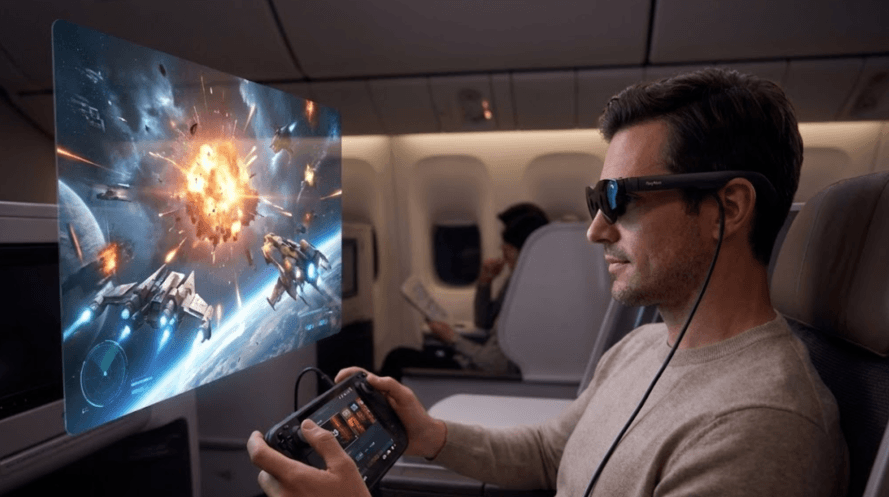
For streaming and movie watching, these two form factors deliver entirely different experiences. One places you inside a virtual theater. The other turns any room, airplane seat, or hotel bed into a private screening room with a floating display.
The AR Advantage: Portable Cinema
The best AR glasses for entertainment project virtual screens that travel with you wherever you go. The RayNeo Air 4 Pro creates a 201-inch equivalent display with HDR10 support — a first in this product category. Quad speakers co-tuned by Bang and Olufsen add spatial audio without requiring separate headphones.
VR Theater Mode
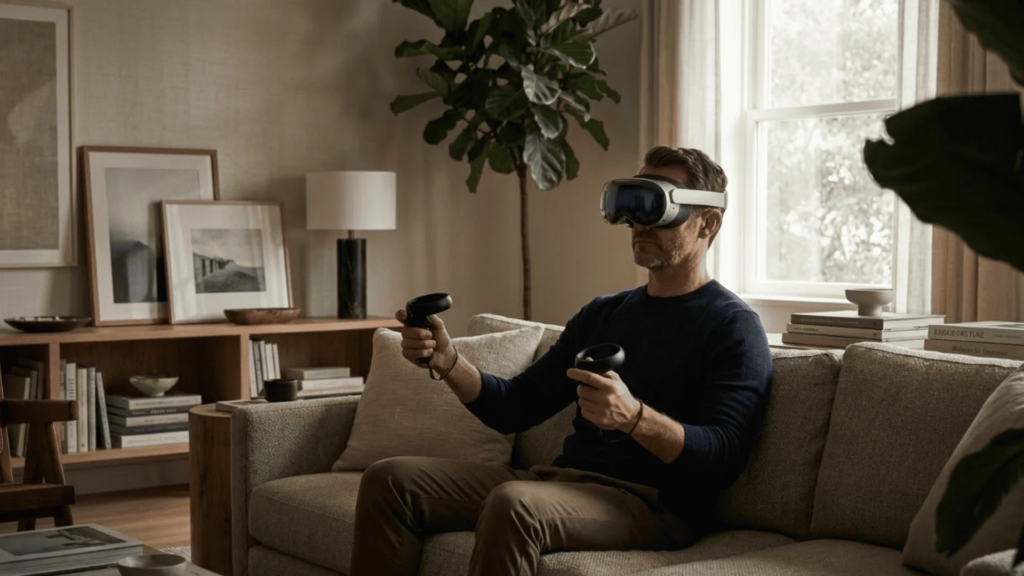
The Meta Quest 3 renders virtual cinema environments where a large screen floats inside a simulated room. Image quality looks sharp, but the 515-gram headset presses against your face throughout the session. Viewing beyond 90 minutes often causes pressure buildup and noticeable heat around the forehead.
Color and HDR Quality
Color accuracy separates the best AR glasses from basic display wearables. The Air 4 Pro covers 98 percent of the DCI-P3 gamut with ΔE below 2, matching professional monitor standards. Its custom Vision 4000 chip also upscales standard SDR content to HDR in real time.
Gaming: Immersion vs. Big-Screen Portability
VR delivers experiences that lightweight glasses cannot replicate. However, the best AR glasses unlock a portable big-screen use case that headsets handle poorly. Your ideal choice depends on what and where you play, guided by three factors that determine which platform fits your gaming style:
- Game type — VR-exclusive titles demand a headset, while console and PC games work through AR display mirroring
- Session comfort — lightweight display glasses support multi-hour play, while VR headsets cause facial fatigue faster
- Portability — the best wearable displays weigh under 80 grams and fit inside a standard glasses case
VR-Native Titles
Beat Saber, Half-Life: Alyx, and Asgard’s Wrath 2 exist only inside VR. These games use room-scale tracking, hand controllers, and 360-degree environments to create full-body interaction. Nothing in the AR category matches this level of physical immersion right now.
Console and Handheld Expansion
Pair a Steam Deck, ROG Ally, or Nintendo Switch 2 with AR glasses and the built-in screen expands to a virtual display over 100 inches. The Air 4 Pro supports adaptive 60 and 120Hz refresh rates with HDR10, making it a strong companion for AAA titles on portable consoles.
See also: Trapstar Australia: More Than Clothing, It’s a Movement
Which Gamers Benefit Most
Each platform leads in different gaming scenarios. The table below compares the two across game type, session length, and social play. For portable console gaming, the best AR glasses deliver clear advantages over any VR headset.
| Use Case | AR Glasses | VR Headsets |
|---|---|---|
| AAA console and PC games | Large virtual screen, HDR, portable | Passthrough limited, heavy |
| VR-exclusive titles | Not supported | Full immersion, motion tracking |
| Handheld gaming | Expands Steam Deck and Switch 2 | Not designed for this use |
| Comfortable session length | Varies by fit and optics | 2.5–3 hours average |
| Local multiplayer | See-through, social-friendly | Isolating by design |
Comfort, Weight, and Eye Safety
Long sessions reveal the biggest practical gap between these form factors. VR headsets press against the face, trap heat, and frequently cause fatigue within two hours. AR glasses sit on your nose like regular eyewear, distributing minimal weight across familiar pressure points.
The numbers tell the story clearly. A 76-gram pair of display glasses exerts roughly one-seventh the facial pressure of a 515-gram VR headset. The RayNeo Air 4 Pro carries TÜV SÜD certification for low blue light and flicker-free operation, backed by 3840Hz PWM dimming technology.
Motion sickness separates the two categories even further. VR headsets trigger simulator sickness in some users due to vestibular conflict between visual motion and physical stillness. Display glasses are generally less prone to cybersickness, though comfort still depends on fit, optics, and session length.
What You’ll Actually Spend
Entry prices only tell part of the full cost story. When you factor in accessories, game purchases, and peripheral add-ons, total ownership cost favors AR glasses over VR headsets for most buyers. Here is what the leading devices cost in April 2026:
| Device | Price | Weight | Device Type |
|---|---|---|---|
| RayNeo Air 4 Pro | $299 | 76g | Tethered display glasses |
| Viture Luma | $399 | 77g | Tethered display glasses |
| XREAL 1S | $449 | 82g | Spatial display glasses |
| Meta Quest 3S | $349.99 | 513g | Standalone MR/VR |
| Meta Quest 3 | $599.99 | 515g | Standalone MR/VR |
| Apple Vision Pro | $3,499 | 600–650g | Spatial computing headset |
VR headsets also carry hidden costs beyond the sticker price that inflate the real ownership number. Dedicated titles run $10–$50 each, elite straps and prescription inserts add $50–$150, and room-scale setups may require clearing furniture.
The best AR glasses bypass many of these extras. On devices with USB-C DP Alt Mode it can be plug-and-play, while some consoles need official accessories. They mirror owned content directly, saving on software purchases for movies, portable gaming, or everyday productivity.
The Bottom Line
VR headsets remain unmatched for full-body immersion and dedicated spatial gaming. For everything else — movies, console gaming, portable productivity, and daily comfort — a quality pair of AR glasses delivers more practical value at a fraction of the weight.
The technology gap narrows each year, but in 2026, most buyers will get more daily use from lightweight AR glasses than from a VR headset that sits on a shelf collecting dust between weekend sessions.