What Home EV Charger Installation Really Costs in 2026

Buying an electric car is the easy part. The question that follows is harder. Where will you charge it, and what will that cost? A regular wall outlet works for some drivers. Most owners want faster home charging. That means a Level 2 charger and an electrician. Prices vary a lot by home. Distance from the panel, panel capacity, and charger type all move the number. This guide breaks down the real costs in plain terms. You will see typical ranges, what pushes a quote up, and how to keep the total down. No jargon, no guesswork, just numbers you can plan around.
How much does a Level 2 charger cost to install?
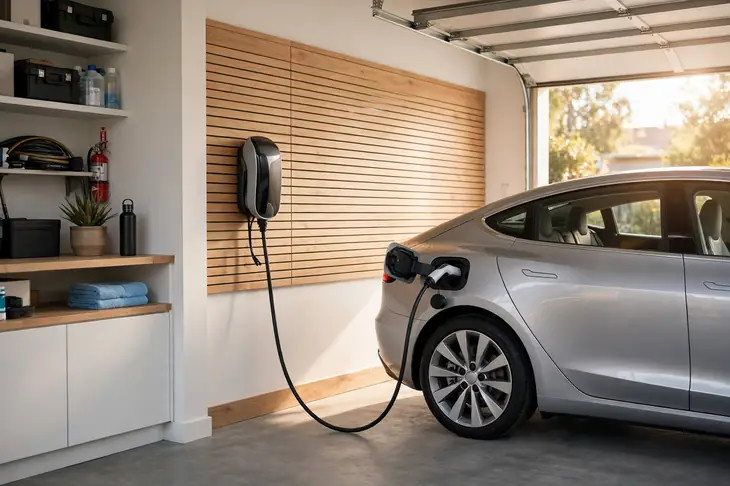
A Level 2 home charger usually costs $1,200 to $2,500 installed, charger included. A typical garage job lands near $1,750. That figure assumes a 40 amp charger that plugs in, about 25 feet from the panel. The electrical work alone usually runs $1,000 to $1,500. The charger itself adds $400 to $700. Long wire runs, detached garages, and panel upgrades can push the total to $3,000 to $6,500. A garage ev charger cost calculator lets you plug in your own setup and see where your job lands. Use it before you call an electrician, so you can spot a quote that looks far too high.
Level 1 or Level 2: which one fits your driving?
Level 1 uses a regular 120 volt outlet and the cord that comes with most cars. It adds about 4 miles of range per hour, or roughly 40 miles overnight. That works if you drive less than that each day. Level 2 needs a 240 volt circuit and charges much faster. Most cars recharge fully overnight on Level 2. A charger that plugs in to a NEMA 14-50 outlet is easy to take with you if you move. A hardwired charger charges faster and suits outdoor use better.
| Setup | Circuit | Power | Range per hour |
| Level 1 outlet | 20 amp | About 1.9 kW | About 4 miles |
| Level 2 plug in | 50 amp | About 9.6 kW | About 30 miles |
| Level 2 hardwired | 60 amp | About 11.5 kW | About 37 miles |
A dedicated Level 1 outlet costs about $600. That is the cheapest path, but it only fits light daily driving. Longer commutes call for Level 2.
What pushes the price up?
Three things move the quote most. First is distance from the panel. Heavy gauge copper wire for a 50 or 60 amp circuit adds about $10 to $12 per foot installed. A charger next to the panel costs the least. A wire run across a basement or attic can add several hundred dollars.
Second is your panel. If it has room and capacity, the added cost is zero. Tandem breakers or panel rework add about $250. A load management device adds about $600. A new subpanel adds about $1,500. A main panel upgrade to 200 amps costs $3,500 to $7,500. Many older homes with 100 amp service cannot add a 50 amp charger circuit without help. Ask about load management before you pay for a full upgrade.
Third is location. An unfinished garage is the cheapest place for a charger. Fishing wire through finished walls adds about $350. An outdoor install adds about $300 for weatherproof boxes and conduit. A pedestal mount adds about $450. A detached garage needs a trench and buried conduit, which usually adds $1,000 to $2,500.
Do you need a permit or an electrician?
Yes, in most cases. Most towns require an electrical permit for a new 240 volt circuit. Permits usually cost $100 to $300. A licensed electrician pulls the permit and books the inspection. Do not improvise this job. A 240 volt circuit carries serious current, and mistakes can damage the car or the house wiring. Get two or three written quotes. Ask each electrician to check panel capacity and include the permit in the quote. Tell them which charger you plan to buy, so every quote covers the same job.
How can you keep the cost down?
Start with placement. Mount the charger close to the panel, even if the car parks farther away. A longer charging cable costs less than a longer wire run. Next, right size the circuit. A 40 amp or even 32 amp charger covers most drivers and may fit your panel without an upgrade. Use load management before you agree to a panel upgrade. It can save $3,000 or more. Check rebates before you buy. Many utilities and some states still offer $250 to $1,000 or more for Level 2 chargers. Note one change for 2026: the federal 30C tax credit ended for chargers placed in service after June 30, 2026. Do not count on it in your budget. Some rebates need a specific model or pre approval, so check your utility website first.
See also: Advanced Tech Cloud 8096380624 Performance
What other garage upgrade should you budget for?
A charger project often exposes other garage problems. While the electrician is there, look at the door. A slow, noisy, or sticking door will only get worse, and it uses the same garage budget. Getting a garage door repair quote at the same time helps you plan the full spend instead of facing a second surprise later. Most door repairs cost $200 to $600, so they are small next to a charger install. Planning both jobs together keeps the garage usable and avoids paying two separate call out fees in the same year.
The bottom line
Budget $1,200 to $2,500 for a Level 2 install, about $1,750 for a typical garage. Check your panel first, keep the wire run short, compare written quotes, and claim every rebate. Do those things and the final number rarely surprises you.